the story of the Hudhud bird in the Quran
The Hudhud bird in Surah An-Naml carries timeless lessons about wisdom, listening, and truth. Explore the story of Prophet Suleiman (AS) and why this small bird still resonates with Muslims today.


There is a small bird mentioned in the Quran that carried knowledge across kingdoms and became part of one of the most remarkable stories in Surah An-Naml.
The Hudhud bird, often translated as the hoopoe, appears in the story of Prophet Suleiman (AS), a prophet known in the Quran for wisdom, justice, and the ability to communicate with animals.
Although the bird appears only briefly in the Quranic narrative, its role carries remarkable meaning. The Hudhud notices something others have missed, travels between distant lands, and returns with information that eventually changes the course of an entire kingdom.
For many Muslims, the story stands out because the Quran gives significance to a small creature that might otherwise go unnoticed. In Surah An-Naml, the Hudhud becomes a symbol of observation, responsibility, intelligence, and truthful communication.
Quick links
- Hudhud in the Quran
- Hudhud story in Surah An-Naml
- Five lessons from the Hudhud story
- Interesting facts about the Hudhud bird
- Prophet Suleiman and the Hudhud story for children
- The Deenista Hudhud collection
Where is the Hudhud mentioned in the Quran
The Hudhud bird is mentioned in Surah An-Naml during the story of Prophet Suleiman (AS).
The word “Hudhud” appears explicitly in the Quran in this verse:
وَتَفَقَّدَ ٱلطَّيْرَ فَقَالَ مَا لِىَ لَآ أَرَى ٱلْهُدْهُدَ أَمْ كَانَ مِنَ ٱلْغَآئِبِينَ
And he sought among the birds and said: How is it that I see not the Hudhud (hoopoe), or is he among the absent?
— Surah An-Naml (27:20)
After this verse, the bird continues to appear throughout the following verses of Surah An-Naml (27:20–28), where it returns with news from the kingdom of Saba’, although the word “Hudhud” itself is not repeated again.
The story of the Hudhud bird in Surah An-Naml
The story takes place during the reign of Prophet Suleiman (AS), who had been blessed by Allah with a kingdom unlike any other. The Quran describes how he was given authority over people, jinn, and animals, and how he understood the speech of birds.
One day, while reviewing his army, Prophet Suleiman (AS) noticed that the Hudhud bird was missing.
He questioned its absence and warned that the bird would need to bring a clear explanation for disappearing.
Shortly afterwards, the Hudhud returned with surprising news. The bird had travelled to the kingdom of Saba’ and discovered a people led by a queen with a magnificent throne and a powerful kingdom. Yet despite their wealth and strength, they were worshipping the sun instead of Allah.
The Hudhud told Prophet Suleiman (AS):
“I have learned something you do not know.”
It is one of the most striking moments in the story. A small bird returns with knowledge that even a prophet had not yet seen.
Rather than reacting immediately, Prophet Suleiman (AS) chose to verify the report. He sent a letter with the Hudhud to the Queen of Sheba, inviting her and her people to worship Allah alone.
This moment eventually becomes the beginning of one of the Quran’s most well-known encounters: the meeting between Prophet Suleiman (AS) and the Queen of Sheba.
Five lessons from the story of the Hudhud in the Quran

Although the Hudhud appears only briefly, the story contains layers of meaning that Muslims have reflected on for centuries.
1. Wisdom is not always tied to status or power
One of the most striking parts of the story is that the Hudhud notices something Prophet Suleiman (AS) has not yet seen.
In everyday life, people often assume that knowledge only belongs to those with status, authority, wealth, or influence. Yet in Surah An-Naml, Allah chooses a small bird to carry important knowledge across kingdoms.
The story becomes a reminder that wisdom and understanding are not always connected to power or reputation. Sometimes insight can arrive from unexpected places, if we are humble enough to actually notice it.
Throughout the Quran, nature repeatedly appears as a source of reflection and understanding. Birds, bees, ants, oceans, mountains, olives, and stars are presented not as meaningless background details, but as signs filled with wisdom and purpose.
If you are interested in how the Quran speaks about the natural world, you may also enjoy reading our article on the female bee miracle in Islam and what it teaches us about community, purpose, and creation.
2. Truthful communication carries responsibility
The Hudhud does not return with gossip or assumptions. It returns with careful observation and truthful information about what it has witnessed in the kingdom of Saba’.
Its message becomes the beginning of a much larger story about guidance and worshipping Allah alone.
The story reminds readers that words carry responsibility. Honest communication, truthful reporting, and sincerity matter deeply in Islam, especially when information has the power to influence others.
In Surah An-Naml, even a small bird becomes trusted with carrying truth across kingdoms.
3. Listening matters before making judgments
The story begins with Prophet Suleiman (AS) noticing that the Hudhud bird is missing from the army.
Even within a vast kingdom, the absence of one small bird is noticed. There is attentiveness and responsibility in the way he leads.
At the same time, Prophet Suleiman (AS) does not rush to punishment when the Hudhud returns. He listens carefully to what the bird has to say and asks for proof before making judgment.
The story becomes a reminder that listening, fairness, and verification matter just as much as authority.
4. Verify information before responding
One of the most relevant lessons in Surah An-Naml is the importance of verification.
When the Hudhud returns with news about the kingdom of Saba’, Prophet Suleiman (AS) does not immediately act on the report. Instead, he sends a letter with the bird and waits to see how the queen and her people respond, confirming the truth of what he has heard before making judgment.
In a world filled with constant information, reactions, and assumptions, this part of the story feels especially timeless.
5. Serving truth is a form of worship
The Hudhud travels, observes carefully, fulfils its responsibility, and becomes part of a much larger story of guidance.
Its role appears small, yet its purpose becomes deeply meaningful.
The story reminds readers that sincere acts of service are not insignificant in Islam. Serving truth, carrying beneficial knowledge, helping others towards guidance, and fulfilling responsibilities with honesty can all become forms of worship.
In Surah An-Naml, even a small bird becomes part of something far greater than itself.
Interesting facts about the Hudhud bird
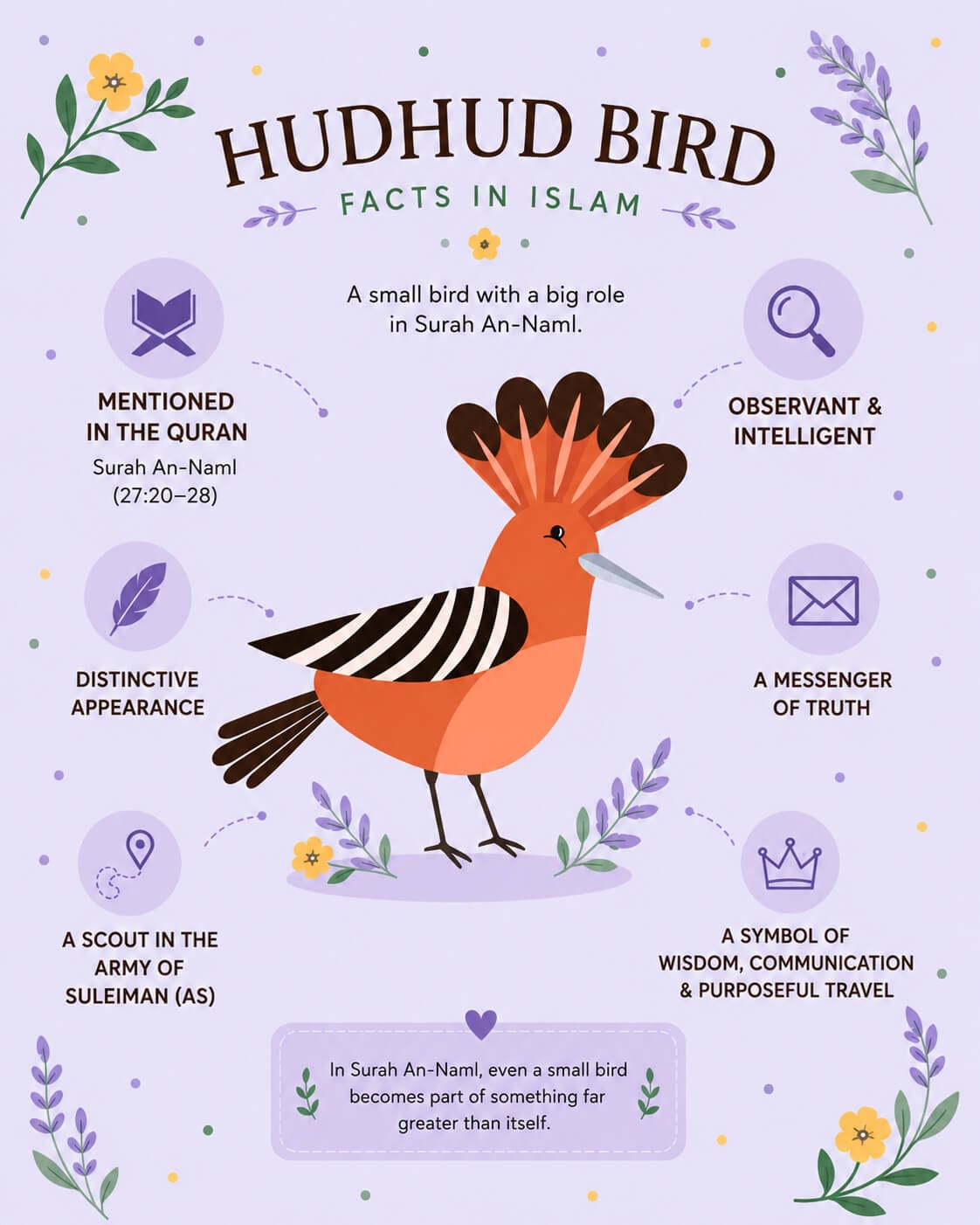
The Hudhud, known in English as the hoopoe bird, is one of the most visually recognisable birds mentioned in the Quran.
It is known for its distinctive feather crown, striped wings, and alert posture, which have made it memorable across art, storytelling, and nature studies for centuries.
According to Islamic tradition, the Hudhud served as a scout in the army of Prophet Suleiman (AS). Some narrations describe the bird as having a remarkable ability to locate hidden water sources during long journeys, helping guide the travelling armies across dry lands.
The Hudhud’s role in Surah An-Naml also reflects its intelligence and observational abilities. The bird notices what others have overlooked and returns carrying important news from a distant kingdom.
In Islamic tradition, the Hudhud is often remembered as a bird connected to wisdom, communication, and purposeful travel.
Prophet Suleiman and the Hudhud story for children
The Amazing Story of Prophet Suleiman and the Hoopoe Bird
Long, long ago, there lived a very special Prophet named Suleiman (peace be upon him). Allah had given him incredible gifts! He could understand the language of all animals and birds, and even talk to them! He was a very wise king, and his army was huge, including humans, jinn (invisible beings), and even birds.
One of his most important birds was a clever little Hoopoe, named Hudhud. Hudhud had a very special job: it could fly high, high up in the sky and use its amazing eyesight to find water hidden deep beneath the earth! Prophet Suleiman relied on Hudhud to help his army find water when they traveled.
Hudhud Goes Missing!
One day, Prophet Suleiman was checking his vast army, and he noticed that Hudhud was missing! Where is Hudhud? he asked. Why don't I see him? Is he absent? Prophet Suleiman was a little upset, because Hudhud was so important. He thought, If Hudhud doesn't come back with a really good reason for being away, there will be trouble!
Hudhud Returns with Incredible News
Suddenly, after a little while, Hudhud flew back! It looked a bit tired but very, very excited. Prophet Suleiman was just about to ask, Where have you been?! but Hudhud quickly began to tell an amazing story!
O Prophet of Allah! chirped Hudhud, I have just flown all the way from a far-off land called Saba (Sheba)! It's ruled by a powerful Queen, and her people have beautiful palaces and many wonderful things, but they are doing something very, very wrong!
Prophet Suleiman listened carefully, his eyes wide with wonder.
They worship the sun instead of Allah, our Creator! Hudhud explained. Shaitan (the devil) has tricked them and made their bad actions seem good to them, so they don't even realize they are making a big mistake! Hudhud was sad that these people were not worshipping the One True God.
Prophet Suleiman's Wisdom
Prophet Suleiman was amazed by Hudhud's news. He realized how important this information was. Even though he was a great Prophet, he didn't know about this far-off land and its people until Hudhud told him! He didn't punish Hudhud for being gone. Instead, he recognized the special knowledge Allah had given to this little bird, a type of knowledge he himself didn't have about that specific place and its people.
Prophet Suleiman quickly wrote a very important letter. In the letter, he invited the Queen and her people to stop worshipping the sun and to worship only Allah, the One True God, who created everything. He sent Hudhud back with this special message.
Print and read together at bedtime
Simply print the story at home and enjoy it together as a cosy bedtime or family reading activity inspired by the story of the Hudhud in Surah An-Naml.