

Have you come across this well-known line about bees?
“If bees were to disappear from the face of the earth, humans would have just four years left to live.”
The quote is often linked to nature scholars. Some say Einstein said it, others say David Attenborough. Whatever its true origin, countless documentaries and studies have shown how deeply human life depends on bees.
But what if we were to tell you that the Quran had already drawn our attention to the bee, its importance, its harmony, and its role in sustaining life more than fourteen centuries ago?
Surah Al-Nahl, The Bee, gives this small creature an entire chapter. Not as a poetic symbol, but as a real sign of divine wisdom. The surah uses the bee to teach us about obedience, balance, healing, and the intricate order behind creation.
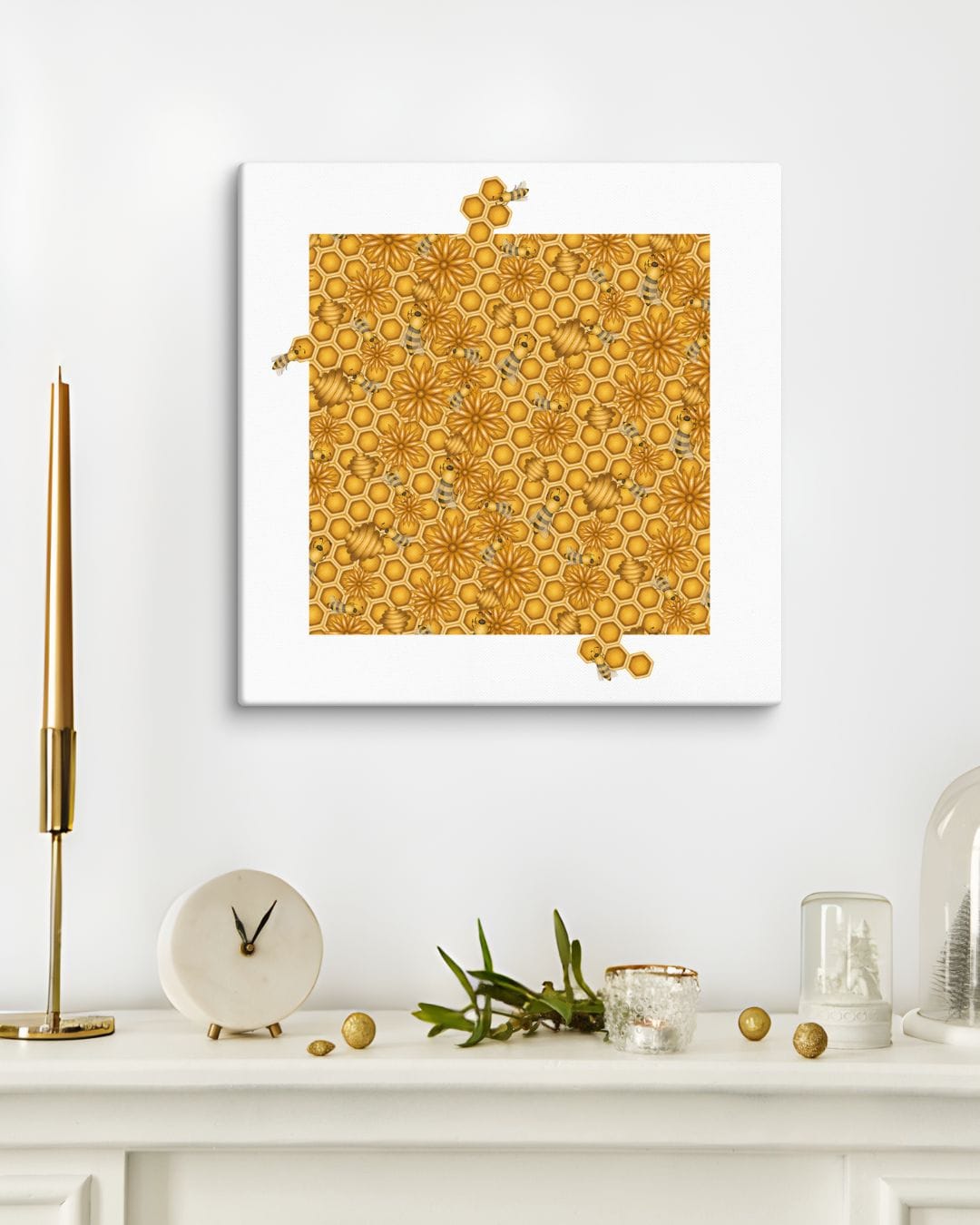
This chapter is also the inspiration behind one of our latest Deenista artworks, a hand-drawn honeycomb and bee motif, later printed on museum-quality canvas. Its purpose is simple: to bring a daily reminder of harmony and gratitude for all the blessings into the home.
Al-Nahl: Blessing and Harmony
This artwork takes its name from Surah an-Naḥl (سورة النحل), often called “the Sura of Blessings.” It is a reminder of the quiet order woven into creation — the honeycomb, the bees, and the harmony that the Quran points to in the natural world.
Now, let’s walk through some of the central themes of Surah Al-Nahl, and after each part, you’ll find a short reminder to carry with you.
1. Tawhid : The certainty of One Creator
Surah Al-Nahl begins by pointing us toward the oneness of Allah. It reminds us of a truth that does not need shouting: that all we depend on comes from one Source. Creation isn’t random, fragmented, or competing. Everything follows a single will.
Every proof of divine unity in this surah comes through things we already know: the sky above us, the rain, the animals, the food we eat. Faith is not presented as something abstract. It is the natural conclusion of looking carefully at the world.
A reminder to carry
• Look at what surrounds you; it already tells you that you are supported, and that your life has direction.2. Divine blessings: Surah Al-Ni‘am
Surah Al-Nahl mentions dozens of blessings, one after another: physical, emotional, and spiritual. The surah almost reads like a gentle inventory of everything we have been given:
- the heavens and the earth
- night and day
- cattle for warmth, clothes, and food
- rain that brings crops back to life
- the miracle of milk
- fruits of every colour
- hearing, sight, and the ability to think
The surah does not simply name these blessings, it invites us to pause long enough to realise how many of them we overlook.
A reminder to carry
• Gratitude begins when you notice what is already in front of you. Most blessings arrive softly, without announcement.3. Signs in creation: where the Bee appears
One of the most beautiful parts of the surah is the way it uses nature as a classroom. Everything becomes an ayah, a sign, if you choose to reflect: mountains, rivers, plants, animals, and finally the bee.
Allah describes how He inspired the bees to build their homes, find pathways in mountains and trees, and produce honey in “varying colours”, containing healing for people. The bee becomes a symbol of obedience, balance, and beneficial work: a creature that takes from the world gently and gives back abundantly.
A reminder to carry
• Move through the world with care. Take only what you need, and leave behind something that benefits others.4. Guidance and revelation: a mercy sent down
Surah Al-Nahl then shifts from the signs in creation to the sign that guides creation: revelation. Allah tells us that He sends the angels with the message, and that the Quran itself is clarity, guidance, and mercy.
Allah says in Surah Al-Nahl (16:89):
“We have sent down to you the Book as clarification for all things, and as guidance, and mercy, and good news for those who submit.”
This guidance is not meant to weigh us down. It is meant to lift, protect, and steady us.
The surah also reminds us that truth is not forced upon anyone. It is offered gently, the way light quietly fills a dark room.
A reminder to carry
• Guidance is a mercy. When you walk toward it, life becomes clearer and more balanced.5. The remarkable detail the Quran gives us: the work of the female bee
One of the most striking parts of Surah Al-Nahl is something many readers miss: the Quran uses feminine verbs when describing the actions of the bee.
In Arabic, verbs change depending on whether the doer is male or female. Even if a group contains one male, the default becomes masculine. Feminine verbs are only used when the doer is entirely female.
In Surah Al-Nahl, Allah uses exclusively feminine verb forms when describing four actions of the bee:
- building its home
- eating from the fruits
- following the pathways inspired by Allah
- producing honey from its belly
This means the Quran is referring to female bees, a detail that was completely unknown in the 7th century. Modern science later confirmed every part of it:
- Only female bees (the worker bees) build the hive.
- Only female bees gather nectar, choose nesting sites, and follow navigational paths.
- Honey is produced in the bellies of female bees.
- Male bees do not gather food or build anything; they exist only to mate once with the queen and die shortly after.
The Quran highlighted this detail centuries before any human discovered the division of labour inside a hive.
It is a subtle, precise linguistic choice, but it carries profound meaning.
A reminder that revelation is exact, intentional, and ahead of human knowledge.
A reminder to carry
• Even the smallest details in the Quran are intentional. When you slow down and look closely, you find wisdom woven into every word.Our Al-Nahl bee artwork was created as a reminder of this: a way to bring a symbol of harmony and blessing into a home.

6. Morality, justice, and how we treat one another
One of the most well-known verses of this surah instructs believers to uphold justice, goodness, and generosity, and to avoid immorality, cruelty, and oppression. It is a timeless ethical map: do what is fair, do what is kind, do what lifts society.
Later, the surah gives us a profound instruction about how to speak to people when conveying truth:
Invite to the way of your Lord with wisdom and kind advice, and debate in the best manner. (16:125)
This verse is the foundation of Islamic etiquette in conversation: dignity, calmness, and respect, even with disagreement.
A reminder to carry
• Strength is not harshness. It lives in clarity, kindness, and dignity — especially in moments of disagreement.7. Reflecting on the bee as a creature
When you look at a hive, you see a small world built on harmony. Bees achieve remarkable things not because any single one is extraordinary, but because they work as one. Their strength comes from unity.
Teamwork and shared purpose
No bee builds a hive alone. They cool the hive together, guard it together, collect nectar together. Tens of thousands move with one intention, almost like a single organism.
Group productivity
What one bee could never accomplish, a whole colony produces with ease. Honey, wax, warmth, protection all of it happens because every bee plays its part without competing or comparing.
Not leaving each other behind
If one bee weakens or cannot complete its task, others step in. The hive protects its own. Productivity never collapses because responsibility is shared.
Allah says:
“The believers are but one brotherhood.” (49:10)
Honest communication
Bees communicate constantly: where nectar is found, when danger appears, when conditions change. Nothing beneficial is hidden. The wellbeing of the colony depends on transparent communication.
Busy with purpose
“Busy as a bee” is not about frantic rushing. It is about being purposeful and disciplined, doing work that matters without ego or noise.
The Prophet ﷺ said:
“Allah will aid His servant as long as the servant aids his brother.” (Muslim)
These are not small lessons. They reflect the very qualities the Quran encourages in believers.
A reminder to carry
• A hive thrives because every member supports the next. Communities do too. When we work with purpose, communicate openly, and refuse to let one another fall behind, extraordinary things become possible.

Read more about the importance of community and health in Islam.
8. The honey: a drink of many colours and a healing sign
Among the most striking verses in Surah Al-Nahl is the one describing what emerges from the bellies of the bees: a drink “of varying colours” in which Allah has placed healing. This detail alone invites reflection.
Honey changes depending on the blossoms bees visit. Its colour, scent, and taste shift with the landscape, yet every variation carries benefit. What the bee gathers, transforms, and releases becomes nourishment and protection for people.
Long before we understood enzymes, nectar sources, or the process inside the “honey stomach,” the Quran spoke of this transformation with precision. And the Prophet ﷺ affirmed its role in healing when he said:
“Make use of the two remedies: honey and the Quran.”
Honey becomes more than a food; it is a lesson in taking from the world gently and returning something beneficial.
A reminder to carry
• What you nurture within yourself shapes what you offer to the world. When the heart is sincere, its actions become healing for both you and others.

If you’re curious about how Islam connects health, nature, and daily habits, you may enjoy our in-depth guide on health in Islam.
Final words: "Be like the bee"
The Prophet Muhammad ﷺ gave us a simple but profound image:
“By the One in whose hand is the soul of Muhammad, the believer is like a bee which eats what is pure and produces what is pure. When it lands on something, it does not break or ruin it.”
(Reported in Musnad Ahmad)
To “be like the bee” is to move through the world with intention, gentleness, and usefulness. Just as the bee gathers what is wholesome and returns something even better, the believer is invited to take in goodness and express it through their words, actions, and relationships.
Being like the bee means:
- Living with purpose
The bee works with clarity, never losing sight of why it was created. A believer, too, keeps the bigger purpose in view. - Choosing what is pure
Bees only gather from what is tayyib — pure and wholesome. In the same way, a believer strives to earn and consume from what is lawful and good. - Speaking carefully
Honey does not appear instantly. It is processed, refined, and softened. Our words should be the same: thoughtful, measured, and aimed at bringing benefit, not harm. - Being gentle in relationships
A bee takes from a flower without damaging it and even helps it grow through pollination. Believers are called to be a source of kindness, mercy, and growth for the people around them. - Honouring each other’s provision
Bees do not steal from another hive’s flower. Likewise, a believer trusts Allah’s rizq and wishes for others what they wish for themselves.
A final reminder to carry
• When the heart is open to guidance, even the smallest creature can teach us something vast. May we be among those who pause, reflect, and recognise the signs placed gently around us.Explore Deenista.shop
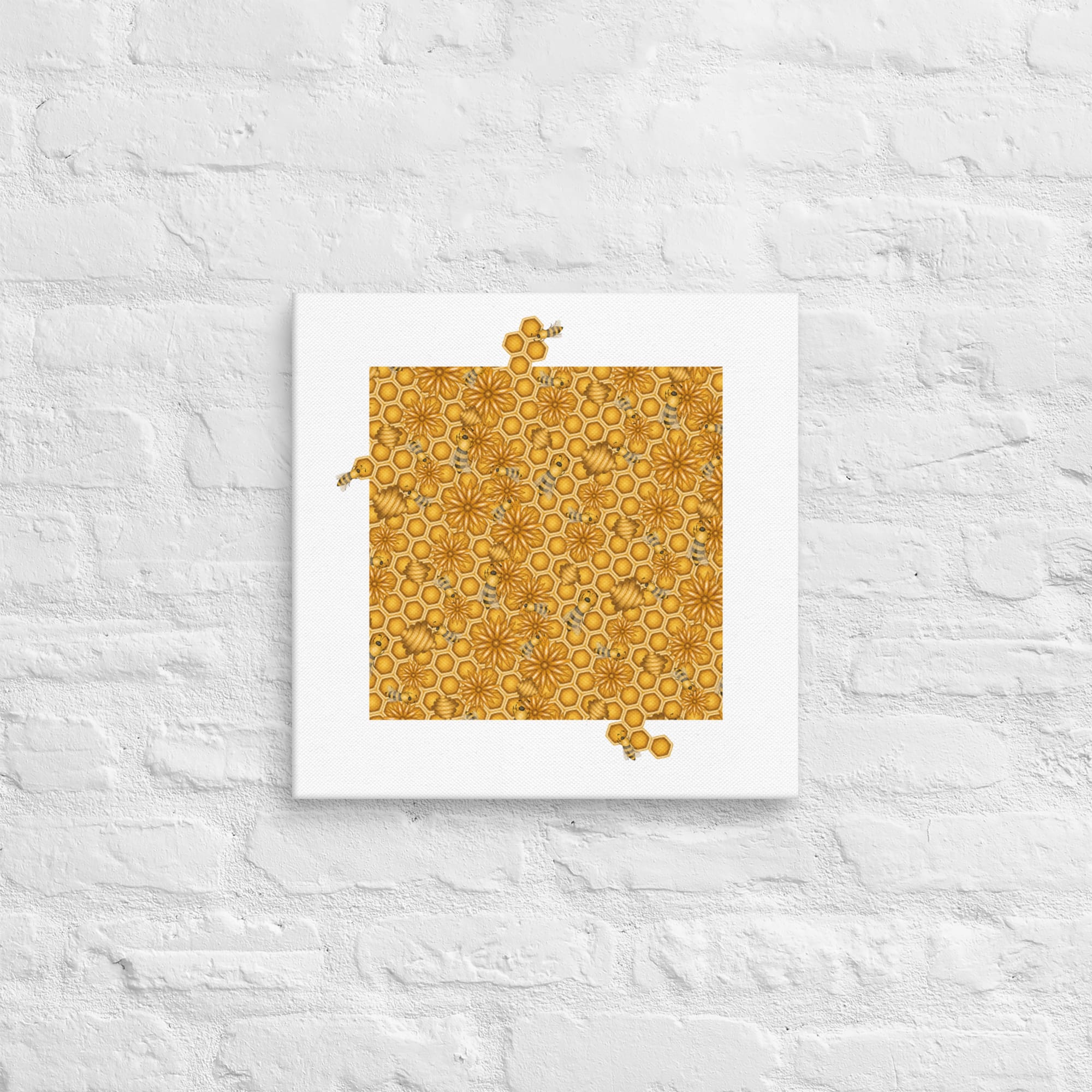
If you’d like to see the artwork inspired by this surah, you can find it in our shop, along with other Islamic-inspired pieces that reflect nature, harmony, and faith.
Explore the full collection at Deenista.shop
This post draws some insights from Be Like the Bee (2nd Ed.) by Muhammad Nabeel Musharraf, licensed under a Creative Commons Attribution 4.0 International License.


