

Golo Morgh (گل و مرغ), meaning “bird and rose,” is one of the most enduring motifs in Persian art.
For centuries, the pairing of the nightingale and the rose has symbolised love, longing, and devotion in Persian poetry, Sufi thought, and visual culture.
In this post, we explore the meaning of Golo Morgh and how this classical Persian tradition continues to shape contemporary interpretations of love in art and interior spaces. We also share how this tradition lives on today through contemporary Golo Morgh Persian wall art created for modern homes.
The many words for love across Persian, Arabic, Urdu and Pashto
In our languages, love has many names.
Eshgh (عشق): consuming, transformative love.
A love that overwhelms, reshapes, and asks for surrender.
Hob (حُبّ): gentle, grounded affection.
Steady and enduring. A love rooted in care rather than intensity.
In Urdu, love often appears as mohabbat (محبت): warm, expressive, and emotionally generous.
It is the language of poetry and everyday speech, love that is spoken and shared.
In Pashto, love is mina (مینه): intimate, tender, and deeply human.
A word that feels lived-in rather than idealised.
Different words, different textures.
Yet across these languages, love is rarely transactional. It is something that shapes the one who loves.
Love beyond romance in Persian and Islamic art
In much of Persian and Islamic poetry, love is not portrayed as a balanced exchange between two equal partners. It is often devotional, longing-driven, and transformative.
The lover gives more than they receive.
The beloved remains distant, luminous, complete.
This asymmetry is not seen as weakness. It is seen as refinement, a sign that love has shaped the one who loves.
It is this understanding of love: patient, inward, and often unreturned, that finds its way into art.
One of the most enduring visual expressions of it lives in a classical Persian painting tradition known as Golo Morgh.
What Golo Morgh actually means
Literally, Golo Morgh means flower and bird.
Symbolically, it means the beloved and the lover.
Most often, the bird is the nightingale (bolbol) and the flower is the rose (gol); a pairing that runs through Persian poetry, Sufi thought, and visual art.
Golo Morgh is not a decorative motif.
It is a philosophy of love.
The symbolism of the flower in Golo Morgh
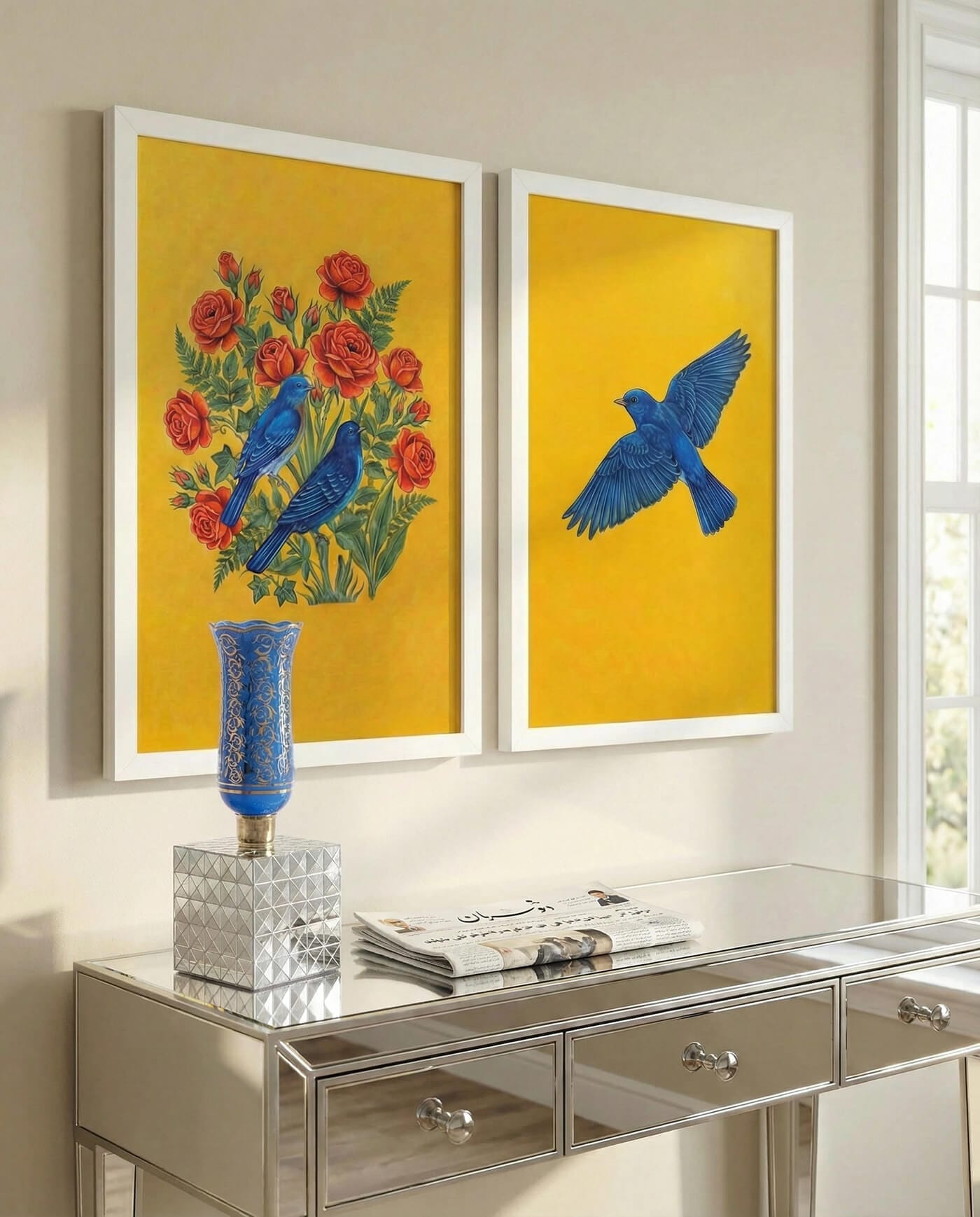
🌹 The flower (Gol)
The flower represents beauty, the beloved, perfection.
It is often still, composed, slightly distant.
It can symbolise:
- a human beloved
- divine beauty: God, truth, the eternal
- the unattainable ideal
The flower does not chase.
It does not explain itself.
It simply exists.
We returned to this idea in our own Golo Morgh artwork.
The symbolism of the bird in Golo Morgh
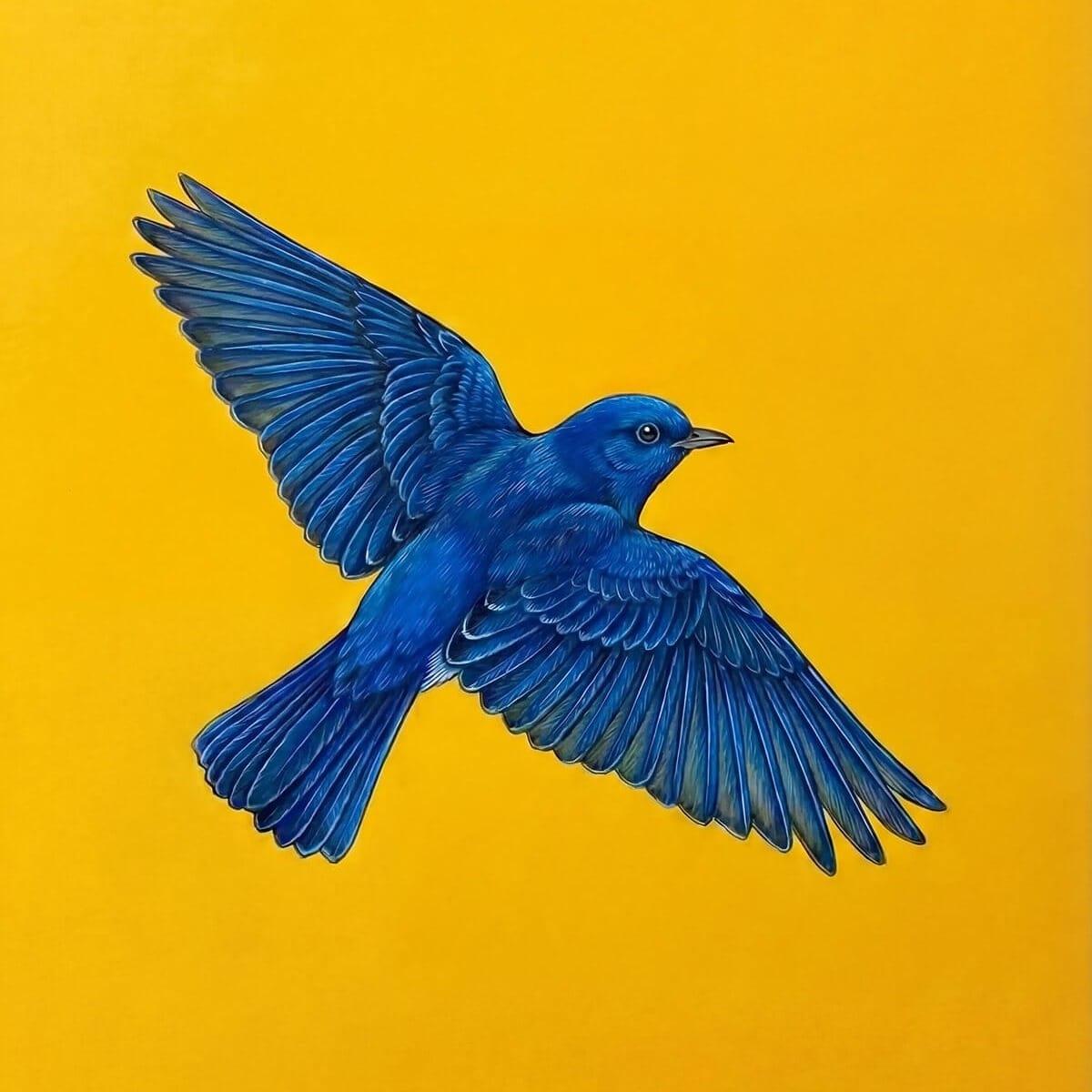
🐦 The bird (Morgh / Bolbol)
The bird represents the lover.
Restless, expressive, emotional.
Often shown leaning toward, circling, or singing to the flower.
It symbolises:
- devotion
- yearning
- the soul in search of meaning
The bird suffers, but willingly.
Love (عشق) in Persian culture
Together, Golo Morgh becomes a portrait of unconditional love.
One is the beloved.
One is the lover.
One remains still.
One cannot help but sing.
This is not imbalance in the modern sense.
It is the language of عشق, a love that gives without measure, like Majnoon loving Leili, like the butterfly drawn to the flame.
In Persian culture, love is not something that must be returned to be real.
It transforms the one who loves, and that, in itself, is enough.
The spiritual meaning of Golo Morgh in Sufi thought
In Sufi interpretation:
- the bird is the human soul
- the flower is divine beauty, God
Love is not possession.
It is proximity without ownership.
That is why Golo Morgh never feels dramatic or theatrical.
It is intimate. Almost private.
Golo Morgh in Persian poetry: Hafez and the nightingale
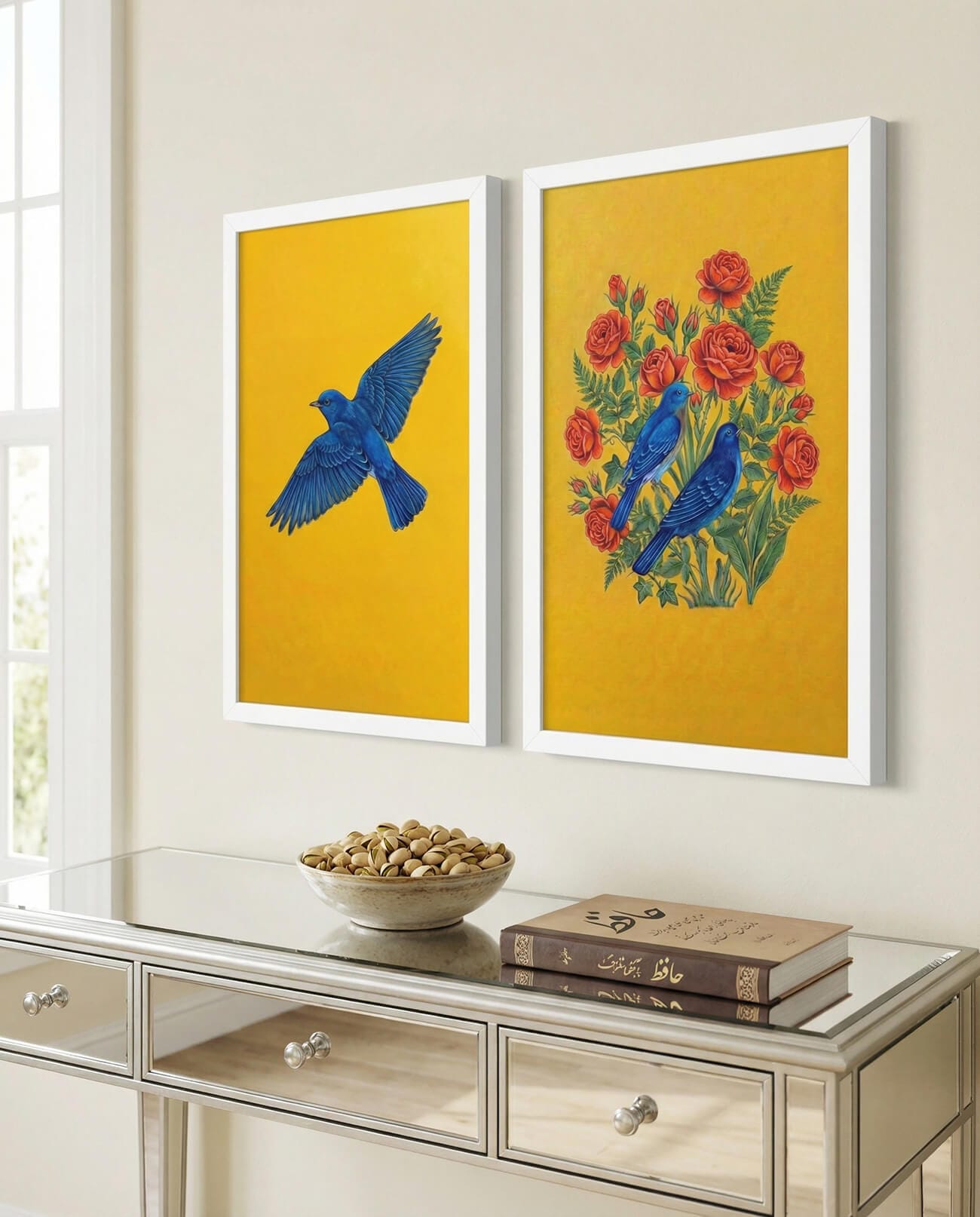
Few poets captured this symbolism as precisely as Hafez.
Hafez: Ghazal 277 (original Persian)
فکرِ بلبل همه آن است که گُل شد یارش
گُل در اندیشه که چون عشوه کند در کارش
Meaning:
The nightingale thinks only of this:
that the rose might become its beloved.
The rose, meanwhile, is occupied
with how to display its own beauty.
And later in the same ghazal:
بلبل از فیضِ گل آموخت سخن، ور نه نبود
این همه قول و غزل تعبیه در منقارش
Meaning:
The nightingale learned its song
from the grace of the rose,
otherwise, how could so much poetry
have been placed within its beak?
Hafez returns to this image to show love as unreciprocated devotion:
the lover consumed by longing,
the beloved complete in its own being.
This is Golo Morgh at its purest.
If Hafez’s poetry speaks to you and you’d like to explore how his verses live on in Persian tradition, you can read more about his role in Yalda night and the ritual of fal-e Hafez in our contemporary Yalda Sofreh post.
“Golo bolbol”: when poetry became everyday language
In modern Persian, the phrase «گل و بلبل» has taken on a different life.
When someone says:
فلانی گل و بلبل میگه
they usually mean that a person is speaking sweetly, using pleasant, flowery words. Compliments, charm, polite talk. Sometimes sincere, sometimes a little light, even a touch la-la-land.
It is striking how the language of art and poetry has found its way into everyday speech.
What once symbolised deep devotion and longing; the lover singing without expectation, has, in daily language, become shorthand for pretty talk.
Perhaps that, too, says something about how love travels through time from poetry, to painting, to language; changing shape, but never quite disappearing.
Why Golo Morgh still speaks to us today
Golo Morgh quietly speaks of:
- longing without entitlement
- love that survives distance
- beauty that does not need to respond to be real
- devotion as dignity, not weakness
Which is very Deenista.
The visual language of Golo Morgh paintings
Traditionally, Golo Morgh artworks are defined by:
- soft, restrained colour palettes
- natural balance rather than symmetry
- gentle curves, no sharp aggression
They appeared on:
- manuscripts
- lacquer boxes
- album pages
- and later, as standalone artworks
Even when decorative, the emotion is always inward.
Our interpretation of Golo Morgh at Deenista
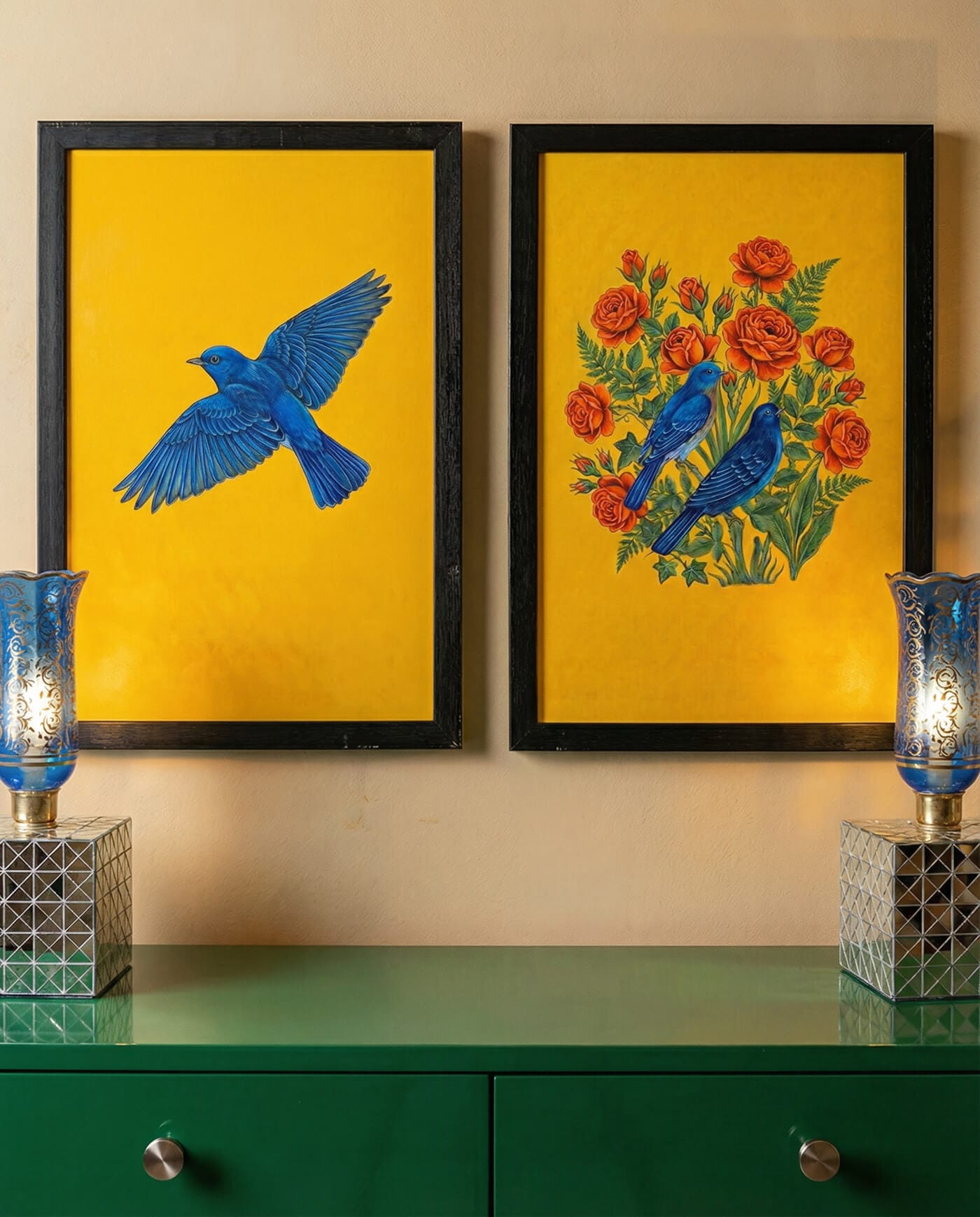
At Deenista, we reinterpret Golo Morgh (گل و مرغ) as contemporary Persian wall art designed for modern interiors.
Our Golo Morgh and Bolbol artworks are available at Deenista.shop for those who wish to bring this tradition into their own homes.
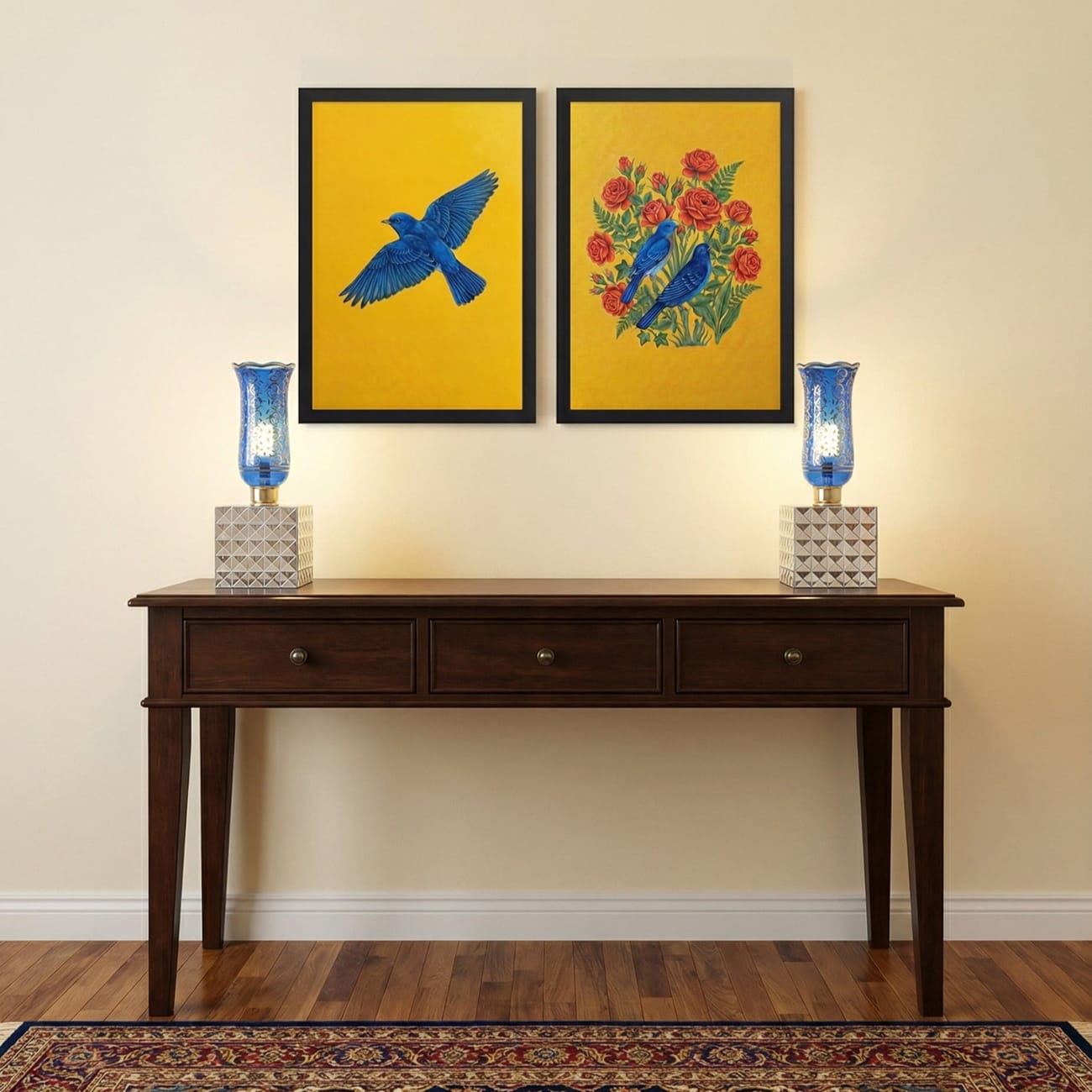
We created two artworks for homes drawn to a more devotional understanding of love. Artworks that honour tradition while allowing space for contemporary interpretation.
contemporary golo morgh Persian wall art
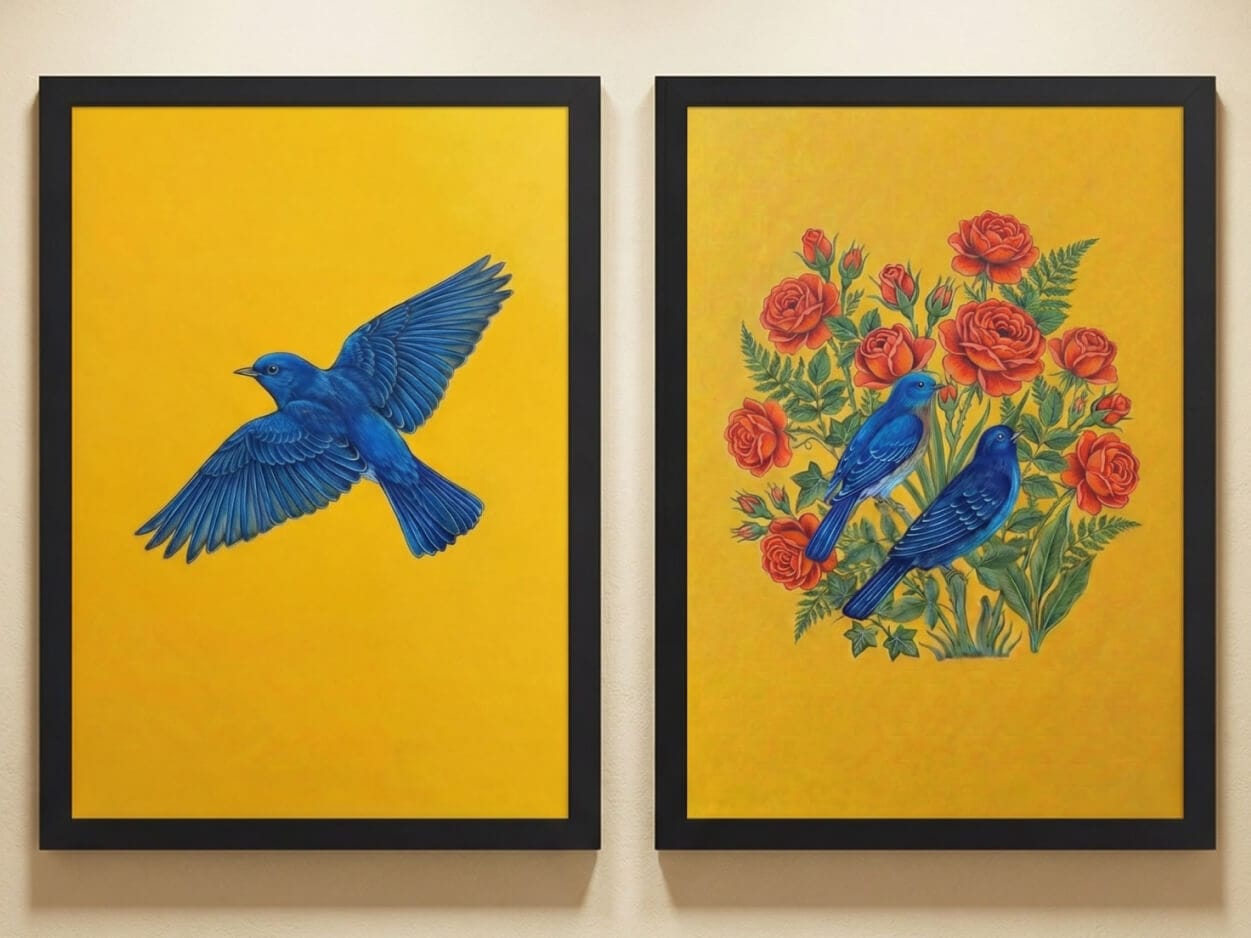
This contemporary Golo Morgh (گل و مرغ) Persian wall art reinterprets the classical bird and rose tradition in a bold, modern composition.
In classical Golo Morgh, the bird and the flower symbolise the lover and the beloved.
In our interpretation, we take this one step further.
We introduce two birds, not as mirrors of one another, but as two lovers turned toward the same source of meaning. Lovers not only of each other, but of divine beauty itself.
One artwork shows a single cobalt-blue nightingale:
the lover alone.
A moment of longing.
A soul mid-song.
The second brings the story together: two birds drawn toward the rose.
Not triumphant.
Not dramatic.
But quietly resolved.
Together, the artworks reflect two states of love:
longing
and presence
Neither louder than the other.
Both held in devotion.
If you’re drawn to art shaped by heritage, symbolism, and quiet meaning, you can explore more pieces inspired by Islamic and cultural traditions in our contemporary Islamic and Persian wall art collection.


