

It often begins with something small. A photo you post on Instagram without thinking, a proud moment shared on TikTok too quickly, a glimpse into your home that feels harmless. A snap of your child smiling in the hallway. A new piece of decor. A holiday snapshot. Nothing dramatic, nothing unusual. Just life.
And yet many of us heard our parents and grandparents warn us about the bad eye or nazar long before social media existed. They spoke about it often, as if it were simply part of the unseen world we should stay aware of. The concept of the evil eye (al-ayn) is not a myth in Islam. It is a real and recognised form of harm, mentioned in the Quran and addressed directly by the Prophet ﷺ. Our elders understood this well.
Still, the way we live today can make us forget. We move through our routines as if visibility is harmless. We share freely, sometimes more than necessary, and only afterwards remember that blessings shown widely can attract more attention than we expect.
During this shift, cultural habits have returned. The blue Turkish eye on a bracelet. A nazar bead hanging in a car. The Hand of Fatima on a necklace. Many believe these symbols offer protection, although this idea comes from culture rather than Islam. Their rising popularity tells us something. It shows that people still feel the need for a reminder that not every gaze is gentle and not every look is harmless.
As our lives become more public, the conversation about nazar and the evil eye becomes more relevant for Muslims.
This post brings together what Islam teaches about the evil eye, the cultural symbols often linked to it — such as the Turkish eye, the nazar bead, and the Hand of Fatima (hamsa, also known as khamsa) — and how Muslims can navigate social media in a way that respects both gratitude and intention.
In summary: The evil eye, cultural symbols and social media at a glance
This post explains three connected areas:
1. What Islam teaches about the evil eye
The evil eye is real. Protection comes through dua, reciting the Quran, sadaqa and practising Tawakkul. Objects do not protect.
2. How cultural symbols like the Turkish eye and Hand of Fatima fit into this
These motifs have cultural history but no spiritual power. They can serve as reminders of awareness, but not as shields.
3. How Muslims can navigate social media today
Modern visibility creates new challenges. A balanced approach includes mindful sharing, protecting children’s privacy, and keeping intention at the centre.
4. Common questions about the evil eye and modern life Many people wonder how the evil eye works today, whether it can affect someone through photos, how to offer blessings when admiring something, and whether it is acceptable to display Turkish eye or Hamsa decor. These questions are addressed in the FAQ at the end of the post.
What Islam actually says about the evil eye
Before we talk about the evil eye, it helps to remember a basic truth in the Quran. Not every look comes from a good place, and people’s feelings can have an effect on others. In Surah al-Falaq, Allah teaches us to seek protection from the harm that can come when envy is present.
“And from the harm of the envier when he envies”
وَمِن شَرِّ حَاسِدٍ إِذَا حَسَدَ
(Surah al-Falaq, 113:5)
This establishes that envy and ill intention are real causes of harm, and that seeking Allah’s protection is important.
Islam is clear about the reality of the evil eye. The Prophet ﷺ said,
“The evil eye is real. If anything were to precede divine decree, it would be the evil eye.”¹
There are also narrations from the Prophet ﷺ that give insight into how the evil eye was understood in everyday life. In one hadith, he speaks about its effects reaching both people and even animals, showing that harmful attention was not seen as abstract, but as something that could touch real situations². The emphasis in these narrations is awareness, not fear.
Another well-known story involves the companion Sahl ibn Hunayf³. A fellow companion admired Sahl while he was bathing, without invoking any blessing. When Sahl later became unwell and this was mentioned to the Prophet ﷺ, he reminded those present of the importance of offering a prayer of blessing when admiring others, redirecting attention toward remembrance and care. This could be expressed through a simple supplication such as:
“May Allah bless you”
بارك الله عليك
BarakAllahu ‘alayk
In everyday life, many Muslims naturally pair admiration with words of remembrance or blessing. These are not formulas, but familiar ways of keeping gratitude and intention at the centre, such as:
“What Allah has willed”
ما شاء الله
Mashallah
and
“There is no power and no strength except through Allah”
لا حول ولا قوة إلا بالله
La hawla wa la quwwata illa billah
This awareness of how attention and intention can affect others is also reflected in the Quran. Many scholars refer to the verse in Surah al-Qalam (68:51):
“And indeed, those who disbelieve would almost make you slip with their eyes”
وَإِن يَكَادُ الَّذِينَ كَفَرُوا لَيُزْلِقُونَكَ بِأَبْصَارِهِمْ
as an indication that harmful intention or envy can affect a person.
The evil eye is real, but it does not act on its own. Its effect depends entirely on Allah’s will. A person’s envy or unguarded admiration can become a means for harm, but nothing happens automatically. Islam encourages awareness, the use of the duas and protections taught by the Prophet ﷺ, and reliance on Allah rather than on fear of negative energies or symbols.
The protections are clear and accessible. Dua, adhkar (أذكار), reciting the Quran, giving sadaqa (صدقة), and placing one’s trust in Allah through Tawakkul.

If you’d like to explore how trust and intention shape the way we live, you can continue with our reflection on Tawakkul.
Sources
1. Sahih Muslim, Hadith 2188
Affirms the reality of the evil eye:
“The evil eye is real. If anything were to precede divine decree, it would be the evil eye.”
From the Book of Greetings (Kitab al-Salam).
2. Bihar al-Anwar, vol. 60, p. 22
Narration describing the potential harm of the evil eye, including the expression that it may cause a man to enter his grave and a camel to end up in the cooking pot.
3. Al-Muwatta of Imam Malik, Book of the Evil Eye (Kitab al-‘Ayn)
Narration of the incident involving Sahl ibn Hunayf, where admiration without invoking blessing caused him harm. The Prophet ﷺ explained the cause and instructed that a blessing be made for him.
Nazar, Turkish Eye and Hand of Fatima: Culture, Colour and Symbolism
Across the Mediterranean, South Asia, the Levant and North Africa, people created different signs and symbols connected to the idea of the evil eye. Some of the most well-known include:
- the blue Nazar bead, often called the Turkish eye
- round glass eye droplets in bright shades of blue
- the Hand of Fatima or Hamsa
Over time, these designs became part of local culture and decoration. Islamic teaching, however, makes it clear that protection comes from Allah alone, and that objects themselves do not hold power.
There is another side to these symbols. They naturally attract attention. The bright blue colour, the bold shapes and the open hand tend to draw the eye straight to them. Culturally, people believed that if someone’s gaze landed on the object first, it was less likely to land on the person or the thing behind it.
For example, hanging a blue eye near a doorway was seen as a way to pull attention toward the colour and away from the home itself. It was more about distraction than protection.
At Deenista, we appreciate these motifs as part of artistic heritage. They carry colour, history and meaning, but not spiritual power. They can be gentle visual reminders of intention and awareness, nothing more.
Our artwork Let the Gaze Pass follows this approach. It can remind you to be thoughtful about what you share, to keep some moments private and to stay mindful when posting about your children. It is an artwork with meaning — not an amulet and not a source of protection.
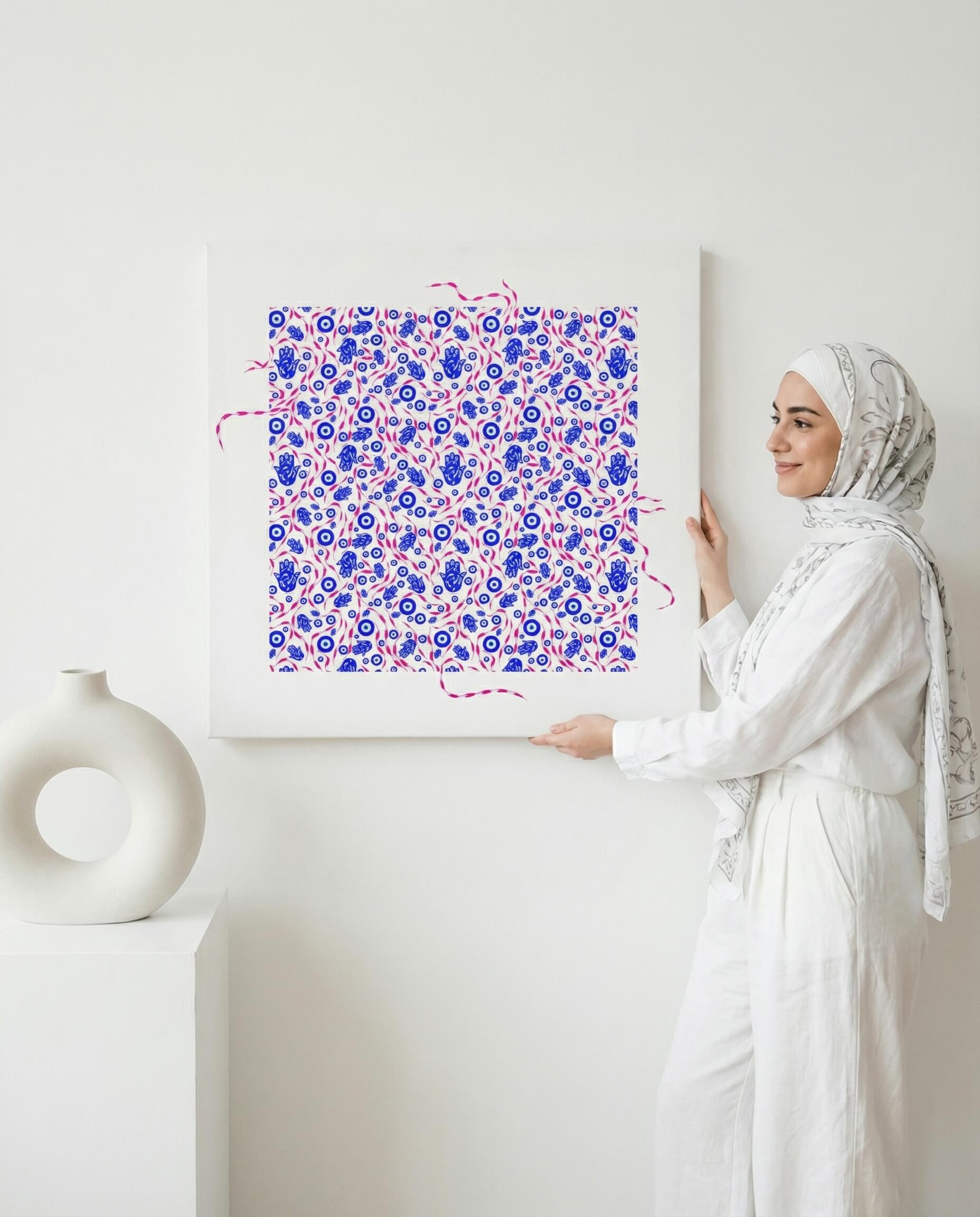
Let the Gaze Pass
A Turkish eye and Hamsa (Hand of Fatima) inspired artwork that gently reminds you of the concept of "Nazar" and the importance of protecting your blessings through dua, sadaqa and mindful living. Originally hand-drawn and printed on canvas.
The evil eye in a world where we share everything
When people spoke about the evil eye in the past, it usually referred to nazar between neighbours, relatives or strangers within a small community. Today, admiration and envy move through social media and the internet, reaching far beyond our immediate surroundings. Images, comments and feeds are no longer limited by distance or location. A photo shared in Dubai can be seen within seconds by someone in New York. This wider exposure adds a new dimension to how we understand the evil eye today.
We share our homes.
We share images of our children.
We share our travels.
We share meals, outfits, purchases and moments throughout the day.
Because the audience is wide and unknown, it becomes harder to understand whose gaze is gentle and whose gaze carries envy.
This is where awareness is important. Not fear, but awareness.
Islam does not ask us to hide every blessing. It asks for moderation, wisdom and intention. The spiritual reality of the evil eye encourages us to think about how we present our lives and why we choose to share certain moments.
Simple questions that can help protect us from Nazar before posting content on social media
Here are a few questions that can ground us before we press “post”:
- Am I sharing this to express gratitude, or to be admired?
This question quickly reveals the real intention behind the post. - Does this benefit anyone, or is it simply performing my life for others?
Not every post needs a purpose, but this question helps reduce unnecessary exposure. - Would I feel the same about this moment if no one else ever saw it?
A way to check whether the moment is meaningful on its own, not only because of an audience. - Does this reveal more about my private life or my children than they would want later?
A protection question, both spiritually and practically. - Is this something I would share if the people I respect most were watching?
A grounding reminder about dignity and modesty. - Is this content feeding gratitude, or feeding comparison?
For you and for those who will see it.
How Islam teaches us to protect ourselves from the evil eye
Islam offers clear steps to protect ourselves and our families:
- Dua & adhkar
The Prophet ﷺ taught specific supplications and daily adhkar for protection, and these remain central. Alongside them, personal dua also matters. Speaking to Allah in your own words, sincerely asking for protection, well-being and goodness for yourself or for others, is part of turning to Him. What matters most is intention and reliance. - Reciting the Quran
Ayat al-Kursi, Surah al-Falaq, Surah al-Nas, and Surah al-Ikhlas are especially emphasised. - Sadaqa
Giving charity is a means of protection in both seen and unseen ways. - Moderation in sharing
Being mindful about what we show is part of humility. - Tawakkul
Trust that harm and protection are in Allah’s hands.
Decorative cultural symbols cannot replace these practices. They may serve as reminders to stay mindful, but they do not protect.
Our artwork Let the Gaze Pass is created with this understanding. It is inspired by the concept of "Nazar", not as a shield but as a reminder of gratitude, giving blessings, keeping our privacy, and good intentions.
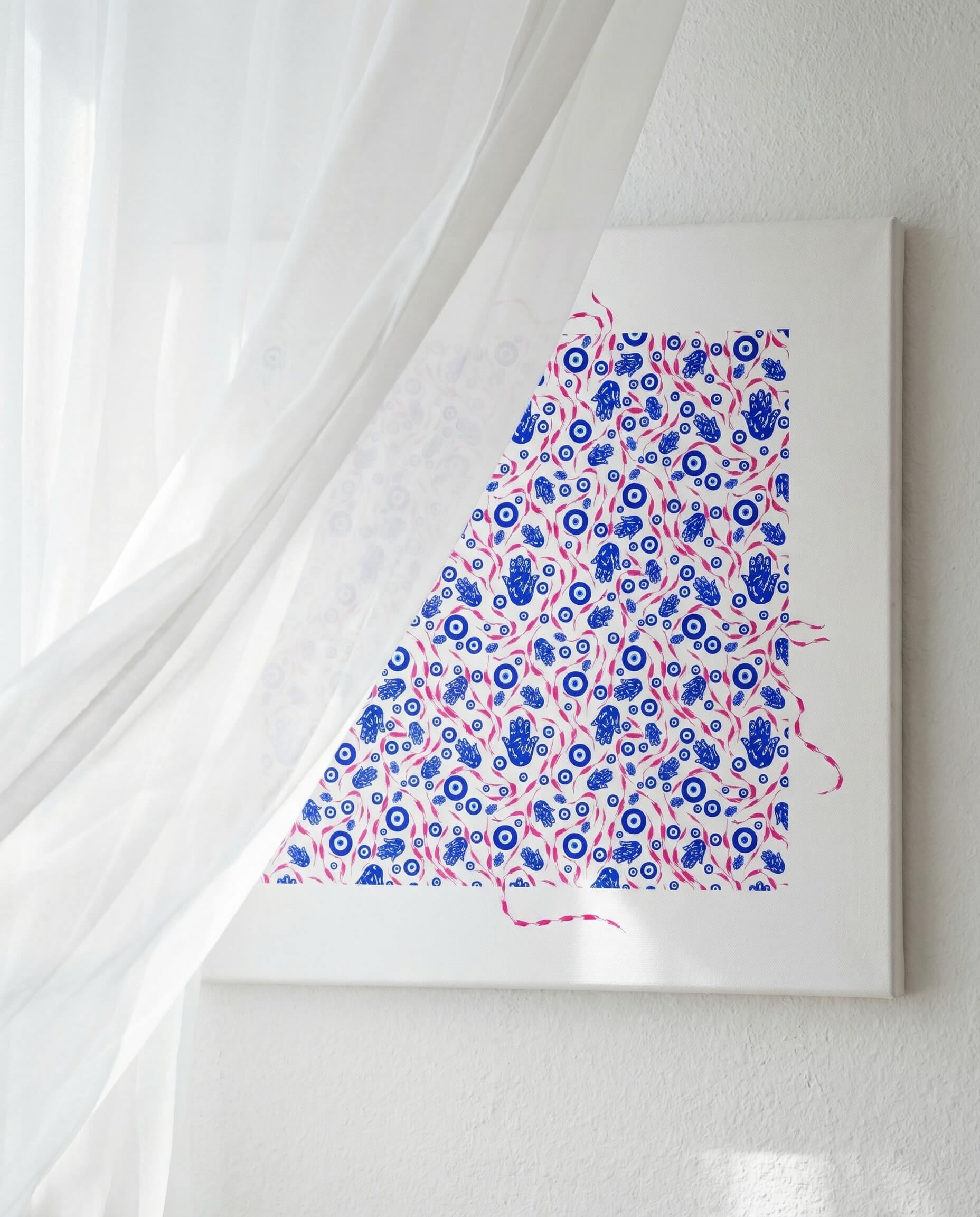
Let the Gaze Pass
A Turkish eye and Hamsa (Hand of Fatima) inspired artwork that gently reminds you of the concept of "Nazar" and the importance of protecting your blessings through dua, sadaqa and mindful living. Originally hand-drawn and printed on canvas.
Can Muslims display Turkish eye or Hand of Fatima decor today?
This is a question many people search for online.
The simplest explanation:
- A helpful way to think about it is intention. If it’s treated as having power, that’s where the discomfort comes in. If it’s decor with no belief attached, many people feel comfortable with it.
- If they are used only as decor, with no belief in their power, many scholars consider it permissible because the intention is aesthetic, not spiritual.
At Deenista, we follow the view that sees these items as reminders for us to stay humble and count our blessings, not protectors.
Between nazar and Tawakkul: a practical guide for navigating visibility today
Finding balance in the age of social media is possible. Islam does not ask us to remove ourselves from society or hide every blessing, but it does ask us to be thoughtful. These principles can help:
1. Enjoy blessings without showing off
A home can be beautiful without becoming a display. Share what feels natural.
2. Stay connected without overexposing your life
You can maintain friendships and community online without showing every detail.
3. Let intention guide your posts
Before sharing, ask yourself why you are posting. Gratitude and connection create healthier choices.
4. Stay aware of nazar without developing fear
Awareness helps you avoid unnecessary display. It is about wise choices, not anxiety.
5. Use the protections Islam teaches
Adhkar, dua, sadaqa and reciting the Quran are the real means of protection.
6. Hold firmly to Tawakkul
Even with all precautions, trust in Allah remains essential. We take steps and rely on Him.
These principles create a balanced way of living that suits both our modern reality and our faith.

For a deeper look at trust, responsibility and letting go of outcomes in a world of constant visibility, you may like our post on Tawakkul.
FAQ: Common Questions About the Evil Eye, Nazar and Modern Life
Is the evil eye real in Islam?
Yes. The Prophet ﷺ confirmed that the evil eye is real and can cause harm by Allah’s permission. Protection comes through dua, adhkar, Quran and sadaqa.
Apart from Quranic verses, are there any duas recommended by the Prophet ﷺ for protection?
Yes. Alongside Quranic recitation, the Prophet ﷺ taught simple supplications for protection that were used regularly, including for oneself and for children. One well-known supplication is:
أَعُوذُ بِكَلِمَاتِ اللَّهِ التَّامَّاتِ مِنْ شَرِّ مَا خَلَقَ
A‘ūdhu bi kalimātillāhi al-tāmmāti min sharri mā khalaq
“I seek refuge in the perfect words of Allah from the evil of what He has created.”
This supplication is reported in hadith collections and is widely used. It reflects a simple approach to protection: turning directly to Allah through remembrance, without relying on objects or symbols.
Can the evil eye affect someone through social media or photos?
Yes. Harm is connected to envy or negative attention. This can occur through images as well as in-person admiration.
Is it allowed to have a Turkish eye or Hamsa (Hand of Fatima) in the home?
If someone believes these items protect them, it becomes problematic. If they are used only as decor without any belief in their power, many scholars consider them acceptable.
What duas or practices protect from the evil eye?
Reciting Surah al-Falaq, Surah al-Nas, Ayat al-Kursi, making daily adhkar and giving sadaqa are all emphasised for protection.
When admiring someone or something, you can also turn your words into a blessing by saying phrases such as Mashallah, BarakAllahu feehi, or BarakAllahu ‘alayk.
What is the difference between nazar and jealousy (hasad)?
Nazar often refers to harm caused by an admiring gaze, even without ill intention. Hasad is deliberate envy. Both are managed through dua, humility and gratitude.
Which phrase should I say when I admire something?
When praising something, you can use any of the following:
- “May Allah bless it” — بارك الله فيه (BarakAllahu feehi)
- “May Allah bless you” — بارك الله عليك / لك (BarakAllahu ‘alayk / laka)
- “What Allah has willed” — ما شاء الله (Mashallah)
- “There is no power and no strength except through Allah” — لا حول ولا قوة إلا بالله (La hawla wa la quwwata illa billah)
All of them turn admiration into a blessing and help prevent harm.
Is it wrong to admire someone’s blessings?
Admiration itself is not wrong. The Prophet ﷺ encouraged us to feel joy for others. Islam simply teaches that pairing admiration with a blessing, such as saying Mashallah or BarakAllahu ‘alayk, is recommended because it turns the moment into something positive.
Are cultural symbols like the Turkish eye haram or just discouraged?
The symbols themselves are not the issue. The problem is believing they protect. If they are used only as decor with no belief in power, many scholars consider them neutral. Islam teaches that protection is from Allah alone.
Is it sinful to show blessings online?
Showing blessings is not automatically sinful. Islam looks at intention and modesty. Sharing with gratitude and benefit is fine. Sharing for admiration or comparison can be unwise. The key is posting with awareness, humility and Tawakkul.
How do I know if I am oversharing?
Oversharing often becomes clear when posting feels habitual, performative or private moments are shared without thought. Asking questions like “Would I still share this if no one could react?” helps keep sharing balanced and intentional.
If I want to compliment someone online, do I need to type the blessing, or is it enough to say it quietly?
It really comes down to intention. Some people like to type Mashallah or BarakAllahu ‘alayk because it feels warm and thoughtful. Others simply say it quietly to themselves. Both are fine. What matters is that the compliment comes from a good place and carries a sense of blessing rather than comparison or envy.
Where does the Hamsa (Hand of Fatima) come from?
The Hamsa, also known as the Hand of Fatima, is a cultural symbol that predates Islam. Historians trace early open-hand symbols to ancient North Africa and the Mediterranean. Over time, the hand motif was adopted by different communities — Jewish (Hand of Miriam), Christian (Hand of Mary) and later Muslim, where it became known as the Hamsa (from the Arabic word خمسة meaning “five”: referring to the five fingers) or Hand of Fatima and was used as an amulet or decorative sign of “protection”.
Islamically, it is important to remember that while the Hamsa is widely used in Muslim cultures, it does not come from the Quran or hadith. It is a cultural symbol with ancient roots, now often appreciated as part of regional heritage and design, rather than as a true source of protection.
Should parents avoid complimenting their children because of nazar?
This idea is common in many cultures, especially among older generations. In Islam, however, expressing love, care and appreciation for children is encouraged. The Prophet ﷺ showed affection openly, spoke kindly to children and praised them. What Islam encourages alongside this is awareness and gratitude. Many parents naturally pair praise with remembrance, such as saying Mashallah or making a quiet dua for their child. The aim is not fear or restraint, but recognising a blessing and turning the heart toward Allah while enjoying it.
Can someone give themselves the evil eye by speaking positively about their own life?
Islam does not teach that a person should be afraid of acknowledging their own blessings. Actually, it's a beautiful act to be mindful and grateful for the good things you have in life. What matters is the inner state. Speaking with gratitude, humility and awareness is different from boasting. Many people naturally say Alhamdulillah when mentioning their own blessings, which keeps the focus on Allah rather than the self. The goal is balance, not silence.